Training Course on Autonomous Driving Sensors and Electrical Architectures
Training Course on Autonomous Driving Sensors and Electrical Architectures meticulously covers the principles, performance, and limitations of key autonomous driving sensors, including LiDAR, Radar, Cameras (visible and infrared), Ultrasonic sensors, and GNSS/IMU for localization and mapping.
Course Overview
Training Course on Autonomous Driving Sensors and Electrical Architectures
Introduction
This comprehensive training course provides an in-depth exploration of Autonomous Driving Sensors and Electrical Architectures, equipping participants with the critical knowledge and practical skills required to design, integrate, and validate the perception and computational backbone of self-driving vehicles. Training Course on Autonomous Driving Sensors and Electrical Architectures meticulously covers the principles, performance, and limitations of key autonomous driving sensors, including LiDAR, Radar, Cameras (visible and infrared), Ultrasonic sensors, and GNSS/IMU for localization and mapping. Participants will gain expert-level understanding of sensor fusion techniques, environmental perception, and the intricate demands placed on the underlying electrical and electronic (E/E) architectures, encompassing high-performance computing (HPC) platforms, communication networks (Ethernet, CAN, FlexRay), and robust power distribution systems. This course is essential for automotive engineers, robotics engineers, and system architects aiming to master the core technological enablers of safe and reliable autonomous vehicles.
The program emphasizes practical considerations and addresses trending topics in the rapidly evolving autonomous driving domain, such as sensor redundancy and diversity, multi-modal sensor fusion algorithms, domain controllers, zonal architectures, functional safety (ISO 26262) for E/E systems, and the application of AI/ML hardware accelerators for real-time processing. Participants will delve into the complexities of data bandwidth management, latency optimization, power efficiency, and cybersecurity for automotive E/E architectures. By the end of this course, attendees will possess the expertise to architect, analyze, and optimize perception systems and electrical architectures for autonomous vehicles, enabling them to lead innovation and overcome the significant engineering challenges in the burgeoning self-driving car industry and intelligent transportation systems. This training is indispensable for professionals driving the future of mobility.
Course duration
10 Days
Course Objectives
- Understand the fundamental principles and capabilities of various autonomous driving sensors (LiDAR, Radar, Camera, Ultrasonic).
- Analyze sensor performance characteristics, limitations, and error sources in diverse operating conditions.
- Comprehend sensor fusion techniques for robust environmental perception.
- Design and implement localization and mapping strategies using sensor data (GNSS, IMU, SLAM).
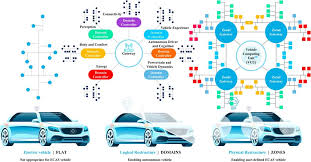
- Evaluate different E/E architectural paradigms (domain, zonal) for autonomous vehicles.
- Understand the requirements for high-performance computing (HPC) platforms for ADAS/AD.
- Design in-vehicle communication networks (Automotive Ethernet, CAN-FD, FlexRay) for high data throughput.
- Apply functional safety (ISO 26262) principles to autonomous driving E/E architectures.
- Address power management and distribution challenges in complex ADAS/AD systems.
- Implement cybersecurity measures for protecting autonomous vehicle sensor and E/E data.
- Explore testing and validation methodologies for ADAS/AD sensor and E/E systems.
- Integrate AI/ML hardware accelerators into perception and decision-making pipelines.
- Design for sensor redundancy and diversity to enhance system reliability and robustness.
Organizational Benefits
- Accelerated R&D cycles for autonomous driving features and vehicle platforms.
- Improved performance, reliability, and safety of ADAS/AD systems.
- Reduced development costs through optimized sensor selection and architectural design.
- Faster integration and validation of complex autonomous driving functionalities.
- Enhanced competitive advantage in the rapidly evolving autonomous vehicle market.
- Development of in-house expertise in critical sensor and E/E architecture domains.
- Compliance with stringent automotive safety standards (e.g., ISO 26262).
- Optimization of data processing and communication pipelines for real-time performance.
- Strengthened cybersecurity posture for autonomous vehicle systems.
- Proactive adaptation to emerging technologies like zonal architectures and new sensor modalities.
Target Participants
- Automotive Engineers (ADAS/AD, E/E Architecture, Software)
- Robotics Engineers
- Systems Engineers
- Electrical Engineers
- Software Developers for Autonomous Systems
- Sensor Development Engineers
- Cybersecurity Engineers (Automotive)
- Test and Validation Engineers for Autonomous Vehicles
Course Outline
Module 1: Introduction to Autonomous Driving and Sensing Principles
- Levels of Driving Automation: SAE J3016 classification (L0-L5).
- The Autonomous Driving Stack: Perception, Localization, Planning, Control.
- Role of Sensors in AD: Environmental perception, redundancy.
- Fundamental Sensing Principles: Active vs. Passive sensors, physics of operation.
- Case Study: Analyzing the sensor suite requirements for an SAE Level 2 highway assist system.
Module 2: Camera Systems for Autonomous Driving
- Camera Types: Visible light, thermal (infrared) cameras, stereo cameras.
- Camera Principles: Lenses, image sensors (CMOS), resolution, frame rate.
- Computer Vision Fundamentals: Object detection, classification, lane keeping.
- Challenges: Lighting conditions, adverse weather, glare.
- Case Study: Evaluating the performance of a monocular camera for lane departure warning and object detection in varying light conditions.
Module 3: Radar Systems for Autonomous Driving
- Radar Principles: FMCW Radar, Doppler effect, frequency bands (24GHz, 77GHz).
- Radar Types: Short-range (SRR), Medium-range (MRR), Long-range (LRR) Radar.
- Advantages: Robust to weather, direct velocity measurement, penetration.
- Limitations: Angular resolution, clutter, ghost targets.
- Case Study: Analyzing how a 77GHz long-range radar contributes to adaptive cruise control and forward collision warning.
Module 4: LiDAR Systems for Autonomous Driving
- LiDAR Principles: Time-of-Flight (ToF), wavelength (905nm, 1550nm).
- LiDAR Types: Mechanical, Solid-State (MEMS, Flash LiDAR).
- Point Cloud Data: 3D mapping, object recognition, free space detection.
- Challenges: Cost, adverse weather (fog, heavy rain), calibration.
- Case Study: Comparing the performance of a multi-beam mechanical LiDAR versus a solid-state LiDAR for 3D mapping in urban environments.
Module 5: Ultrasonic and Other Sensors
- Ultrasonic Sensors: Principles, range, applications (parking assist, low-speed maneuvers).
- GNSS (GPS, GLONASS, Galileo): Principles, accuracy, limitations (urban canyons).
- IMU (Inertial Measurement Unit): Accelerometers, gyroscopes, dead reckoning.
- Wheel Speed Sensors: Odometry, basic localization.
- Case Study: Designing a sensor combination for low-speed autonomous parking, integrating ultrasonic and camera data.
Module 6: Sensor Fusion Techniques
- Why Sensor Fusion? Redundancy, robustness, improved accuracy.
- Levels of Fusion: Low-level (raw data), Mid-level (feature-level), High-level (object-level).
- Fusion Algorithms: Kalman Filters, Extended Kalman Filters, Particle Filters.
- Probabilistic Approaches: Occupancy grids, Bayesian inference.
- Case Study: Implementing a simple Kalman Filter to fuse radar and camera data for more accurate object tracking.
Module 7: Localization and Mapping for Autonomous Driving
- Global Localization: Using GNSS, HD Maps.
- Local Localization: Odometry, IMU integration.
- Simultaneous Localization and Mapping (SLAM): Building maps while localizing.
- High-Definition (HD) Maps: Role in autonomous driving.
- Case Study: Describing how a combination of GNSS, IMU, and LiDAR data is used for precise localization in an urban setting.
Module 8: Introduction to Automotive Electrical/Electronic (E/E) Architectures
- Evolution of E/E Architectures: From distributed ECUs to centralized domains.
- Domain Controllers: Centralizing functions (e.g., ADAS domain controller).
- Zonal Architectures: Physical grouping of functions for wiring simplification.
- Software-Defined Vehicles (SDV): Decoupling hardware and software.
- Case Study: Comparing the benefits and challenges of a traditional distributed E/E architecture vs. a domain-controller based architecture for a complex ADAS system.
Module 9: In-Vehicle Communication Networks
- CAN (Controller Area Network): Classic, FD (Flexible Data-Rate) for robust, lower-speed communication.
- FlexRay: High-speed, time-triggered communication for critical applications.
- Automotive Ethernet: High-bandwidth backbone for sensors, infotainment, HPC.
- LIN (Local Interconnect Network): Low-cost, low-speed for simple sensors/actuators.
- Case Study: Designing a communication network for an L3 autonomous vehicle, allocating sensor data streams to appropriate bus technologies.
Module 10: High-Performance Computing (HPC) for ADAS/AD
- Computational Requirements: Processing sensor data, running ML models, planning.
- Processors: CPUs, GPUs, FPGAs, ASICs (AI Accelerators).
- Memory and Storage: RAM, non-volatile memory for algorithms and data.
- Platform Architectures: Scalability, thermal management.
- Case Study: Evaluating the computational needs for real-time object detection using a deep neural network from multiple camera streams.
Module 11: Power Management and Distribution
- High-Voltage and Low-Voltage Systems: Powering sensors, ECUs, actuators.
- Power Distribution Units (PDUs): Fuses, relays, intelligent power switches.
- Voltage Regulation and Filtering: Ensuring stable power supply to sensitive electronics.
- Redundancy in Power Supply: For critical ADAS/AD functions.
- Case Study: Designing a robust power distribution network for the sensor suite and HPC unit of an autonomous vehicle.
Module 12: Functional Safety (ISO 26262) for ADAS/AD E/E Systems
- Introduction to ISO 26262: Hazard Analysis and Risk Assessment (HARA).
- ASIL Determination: Automotive Safety Integrity Levels for E/E components.
- Safety Concepts: Technical safety requirements, safety mechanisms.
- Fault Injection and Testing: Validating safety mechanisms.
- Case Study: Performing a basic HARA for a LiDAR system in an autonomous emergency braking (AEB) application.
Module 13: Cybersecurity for Autonomous Vehicle E/E Architectures
- Threat Vectors in ADAS/AD: Sensor spoofing, ECU compromise, communication attacks.
- Secure Boot and Firmware Updates: Protecting against unauthorized modifications.
- Intrusion Detection Systems (IDS) for In-Vehicle Networks: Monitoring for anomalies.
- Secure Communication (TLS, IPsec): Protecting data in transit.
- Case Study: Identifying potential cybersecurity vulnerabilities in an Ethernet-based sensor data pipeline and proposing mitigation strategies.
Module 14: Testing, Validation, and Calibration
- Sensor Calibration: Intrinsic and extrinsic calibration for accuracy.
- Hardware-in-the-Loop (HIL) Testing: Validating ECUs and control algorithms.
- Software-in-the-Loop (SIL) Testing: Early stage algorithm validation.