Training Course on Construction Risk Management and Mitigation
Training Course on Construction Risk Management and Mitigation is designed to equip individuals and organizations with the practical knowledge and skills necessary to implement robust Risk Management Frameworks within their construction projects.
Skills Covered
Course Overview
Training Course on Construction Risk Management and Mitigation
Introduction
In the dynamic and often unpredictable landscape of the construction industry, effective Construction Risk Management is paramount for project success and the safeguarding of stakeholder interests. This comprehensive training course delves into the critical processes and techniques for identifying, assessing, analyzing, and mitigating potential risks that can impact project timelines, budgets, quality, and safety. Participants will gain invaluable insights into proactive risk management strategies, enabling them to navigate uncertainties and make informed decisions throughout the project lifecycle. Mastering Risk Mitigation Strategies is no longer optional but a fundamental requirement for construction professionals seeking to enhance project resilience and achieve optimal outcomes in today's competitive environment.
Training Course on Construction Risk Management and Mitigation is designed to equip individuals and organizations with the practical knowledge and skills necessary to implement robust Risk Management Frameworks within their construction projects. By understanding the nuances of Risk Identification Techniques and the application of various Risk Assessment Methodologies, attendees will be empowered to proactively address potential challenges. The course further explores a range of Risk Response Planning approaches and the effective utilization of Risk Control Measures to minimize negative impacts. Through real-world case studies and interactive exercises, participants will develop the competence to foster a Risk-Aware Culture within their teams and contribute significantly to project success through diligent Contingency Planning and the application of industry best practices in Construction Safety Management and Project Risk Analysis.
Course Duration
5 days
Course Objectives
Upon completion of this training course, participants will be able to:
- Implement effective Construction Risk Identification processes to proactively uncover potential threats.
- Apply various Risk Assessment Techniques to evaluate the likelihood and impact of identified risks.
- Develop comprehensive Risk Analysis Methodologies for informed decision-making.
- Formulate robust Risk Mitigation Strategies to minimize the negative consequences of risks.
- Create detailed Risk Response Plans outlining actions to be taken when risks occur.
- Utilize effective Risk Control Measures to monitor and manage risks throughout the project lifecycle.
- Establish clear Contingency Planning protocols to address unforeseen events.
- Foster a proactive Risk-Aware Culture within construction project teams.
- Integrate Construction Safety Management principles into risk management practices.
- Apply Project Risk Analysis tools and techniques for better project outcomes.
- Understand the legal and contractual implications of Construction Risk Allocation.
- Leverage Technology in Risk Management for improved efficiency and accuracy.
- Communicate effectively about Stakeholder Risk Management and expectations.
Organizational Benefits
- Reduced project cost overruns through proactive risk mitigation.
- Improved project delivery timelines and enhanced efficiency.
- Increased project quality and adherence to specifications.
- Enhanced safety performance and reduced workplace accidents.
- Stronger stakeholder confidence and improved reputation.
- Better decision-making through informed risk analysis.
- Greater resilience to unforeseen challenges and market fluctuations.
- Development of a risk-aware and proactive organizational culture.
Target Audience
- Project Managers
- Construction Engineers
- Site Supervisors
- Contract Administrators
- Quantity Surveyors
- Health and Safety Managers
- Risk Managers
- Construction Business Owners
Course Outline
Module 1: Foundations of Construction Risk Management
- Understanding the nature and sources of risks in construction projects.
- The importance and benefits of proactive risk management.
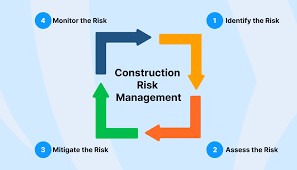
- Overview of the risk management process: identification, assessment, analysis, response, and control.
- Establishing a risk management framework within a construction organization.
- Case Study: Analysis of a major project failure due to inadequate risk management.
Module 2: Risk Identification Techniques
- Brainstorming and checklists for identifying potential risks.
- SWOT analysis and its application in construction risk identification.
- Review of historical data and lessons learned from past projects.
- Stakeholder analysis and identification of their potential risks.
- Case Study: Implementing a risk identification workshop for a complex infrastructure project.
Module 3: Risk Assessment and Analysis
- Qualitative risk assessment: probability and impact matrices.
- Quantitative risk assessment: expected monetary value (EMV) and sensitivity analysis.
- Monte Carlo simulation for probabilistic risk analysis.
- Risk register development and maintenance.
- Case Study: Using quantitative risk analysis to determine project contingency budgets.
Module 4: Risk Response Planning and Mitigation Strategies
- Developing risk response strategies: avoid, transfer, mitigate, accept.
- Implementing risk mitigation techniques for various risk types (e.g., technical, financial, schedule).
- Contingency planning and the development of fallback plans.
- Insurance and bonding as risk transfer mechanisms.
- Case Study: Developing a risk response plan for potential weather delays on a critical project.
Module 5: Risk Control and Monitoring
- Establishing key risk indicators (KRIs) for monitoring risk exposure.
- Regular risk reviews and audits throughout the project lifecycle.
- Change management processes and their impact on risk.
- Documentation and reporting of risk management activities.
- Case Study: Implementing a risk monitoring system for a long-duration construction project.
Module 6: Legal and Contractual Aspects of Risk Management
- Understanding risk allocation in construction contracts.
- Force majeure clauses and their implications.
- Dispute resolution mechanisms and risk mitigation.
- Insurance requirements and liability issues in construction.
- Case Study: Analyzing a contract dispute related to unforeseen ground conditions.
Module 7: Human Factors and Risk Culture
- The role of communication and collaboration in effective risk management.
- Developing a risk-aware culture within project teams.
- Leadership's influence on risk management practices.
- Training and competency building for risk management.
- Case Study: Transforming a reactive project team into a proactive risk-aware culture.
Module 8: Emerging Trends and Technologies in Risk Management
- The use of BIM (Building Information Modeling) for risk identification and visualization.
- Leveraging data analytics and AI for predictive risk management.
- Digital tools and software for risk management.
- Sustainability and climate change risks in construction.
- Case Study: Utilizing BIM to identify and mitigate spatial conflicts in a complex building design.
Training Methodology
This course will employ a blended learning approach, incorporating:
- Interactive lectures and presentations
- Group discussions and collaborative exercises
- Real-world case study analysis
- Practical workshops and simulations
- Q&A sessions and knowledge sharing
Register as a group from 3 participants for a Discount
Send us an email: info@datastatresearch.org or call +254724527104
Certification
Upon successful completion of this training, participants will be issued with a globally- recognized certificate.
Tailor-Made Course
We also offer tailor-made courses based on your needs.
Key Notes
a. The participant must be conversant with English.
b. Upon completion of training the participant will be issued with an Authorized Training Certificate
c. Course duration is flexible and the contents can be modified to fit any number of days.
d. The course fee includes facilitation training materials, 2 coffee breaks, buffet lunch and A Certificate upon successful completion of Training.
e. One-year post-training support Consultation and Coaching provided after the course.
f. Payment should be done at least a week before commence of the training, to DATASTAT CONSULTANCY LTD account, as indicated in the invoice so as to enable us prepare better for you.